designing in cuts
how to gain conviction in design

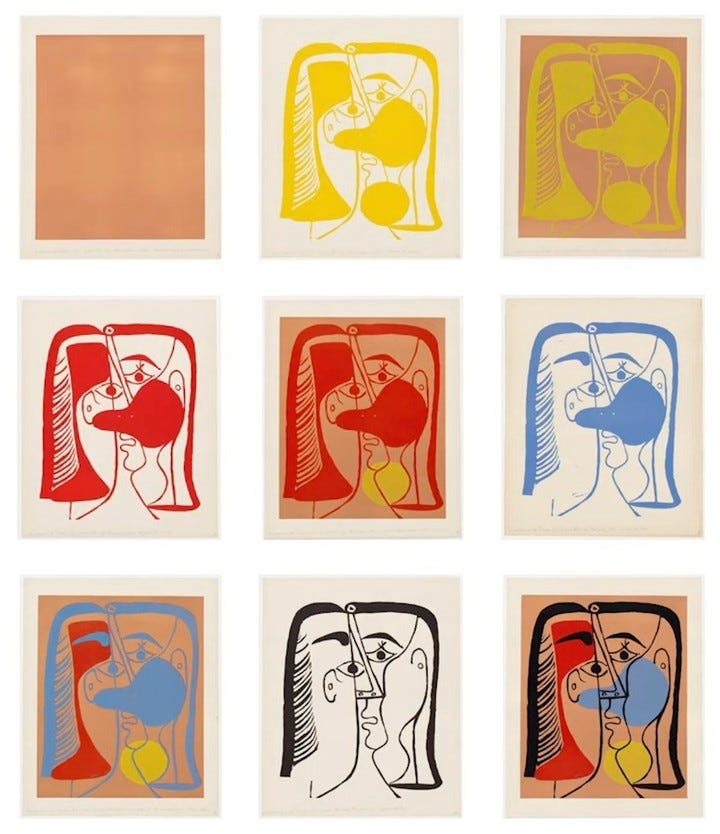
there’s an old printmaking technique called reduction linocut. you start with a single block of linoleum. you carve away what you don’t need, ink what’s left, press it onto paper. then you carve more away. ink again. press again. layer by layer, color by color, the image emerges — not by adding, but by removing.
every cut is permanent. you can’t glue the lino back. you can’t undo the cut. and once you’ve printed the edition, the block is destroyed. the finished work is the only record that it ever existed.
i think about this a lot when designing lately: about how much we take for granted, and how we lose conviction in the process.
the instinct with UI is to add. another toggle. another tooltip explaining the thing that shouldn’t need explaining. we accumulate features like sediment — well-intentioned additions until the interface is buried under its own helpfulness. i’ve sat in product reviews where someone says “what if we added a setting for that?” and i always want to respond: what if we fucking didn’t? what if instead of giving people a switch, we just made the right call?
but that requires conviction. and conviction is expensive in an industry that worships optionality. we’ve built entire workflows around the idea that no decision is final — and so nothing feels final. the mockup becomes a suggestion. the design review becomes a brainstorm. every decision is soft because every decision can be undone.
i used to think that flexibility was the whole point of digital tools. infinite undo, infinite iteration. now i’m less sure. the printmaker carves with intention because there is no cmd+z. every cut is a bet — this matters, this doesn’t. that focus produces a clarity i rarely see in design that’s been option + dragged into existence. maybe infinite possibility is what makes so many interfaces feel like they were designed by nobody in particular.
which is maybe why i keep coming back to picasso’s linocuts.
he’d print a few proofs at each stage, then destroy the block by carving deeper. the harvard art museums have some of his progressive states — you can see him making irreversible calls, watching the image sharpen as material disappears. this shape was committed early. this color was locked in before he knew what the final composition would look like. he was designing forward into uncertainty, each cut narrowing what’s possible while somehow making the result feel more inevitable.
we prototype and test and hedge until the thing that ships is the average. picasso couldn’t do average. the block wouldn’t let him. and so each proof has a point of view that’s hard to arrive at when everything is negotiable.
but what strikes me most looking at those progressive states isn’t the conviction — it’s the physicality. you can almost feel him working with the grain of the material. lino has a resistance. soft enough to carve, firm enough to hold detail. the tool slips and you incorporate the accident. some of the best marks in a reduction print are the ones nobody planned.
code has a grain like that. every framework, every component library has opinions about what’s easy and what’s hard. most designers never feel that grain because they’re working in abstraction: pushing pixels that don’t know what a flexbox is, drawing rectangles that have never heard of state. and then they hand the drawing to an engineer and say “make it look like this,” which is a bit like handing a woodworker a photograph of a chair and asking them to ignore how wood as a material behaves.
when you design in the actual material — when your design tool and your code are the same thing — the resistance becomes a conversation. the material tells you where it wants to go. you just have to be close enough to hear it.
Gardening; not architecture.
– Brian Eno
brian eno once described the difference between the architect and the gardener. the architect plans everything upfront, executes the plan, done. the gardener plants seeds and responds to what grows. shaping, pruning, watching, adjusting.
i’d add a third figure: the printmaker. the printmaker plans, but loosely. commits, but incrementally. each cut closes one door and opens the next layer. it’s less controlled than architecture, more deliberate than gardening. you’re working toward something you can’t fully see, making permanent choices along the way, trusting that the accumulation of good cuts will get you somewhere worth arriving.
that’s closer to how design actually works, at least for me. you don’t know the whole picture at the start. you make a cut. you see what’s revealed. you make another. and at some point the block gets light enough that you realize there’s nothing left to remove.